
Signs Your Calgary Commercial Roof Needs Replacement


Quick Answer: A Calgary commercial roof typically needs replacement when annual repair spending exceeds 25% of replacement cost, insulation tests wet on an infrared scan, ponding water persists 48+ hours after rain, membrane blistering or seam separation covers more than 10% of the field, or the membrane has reached 80% of its rated life. Repeat tenant leak complaints over consecutive seasons usually confirm the diagnosis.
A commercial roof rarely fails overnight. It signals end-of-life through a pattern of escalating symptoms across 2 to 5 years. Catching the pattern early lets you plan a capital project on your schedule, with proper budget approval, instead of reacting to a tenant leak during a Chinook. This article walks through the diagnostic signs Calgary property owners and asset managers should track, what each symptom usually means, and when the evidence stacks into a clear replacement decision.
At a Glance
Quick Facts:
Inflection point: Annual repair spend exceeds 25% of replacement cost
Wet insulation indicator: Infrared scan shows thermal anomalies; nuclear or capacitance scans confirm
Ponding threshold: Water remaining 48+ hours after rainfall indicates drainage failure
Visible deterioration: Blistering, alligatoring, or seam separation across 10%+ of the field
Life-cycle marker: Membrane at 80%+ of rated lifespan
Tenant signal: Repeat leak complaints over 2+ seasons in different roof zones
Persistent Ponding Water
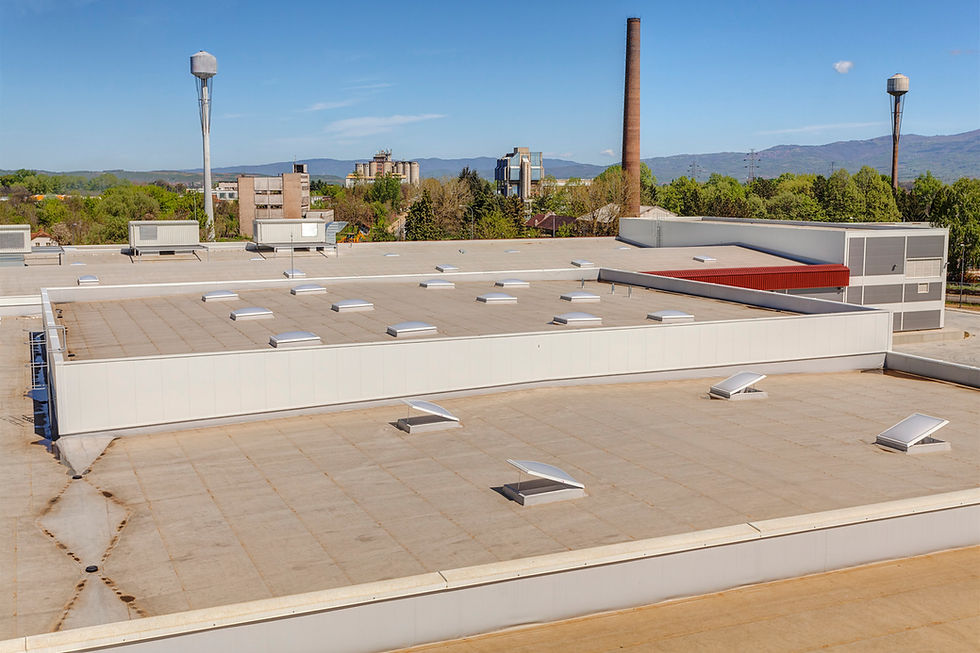
A low-slope commercial roof should drain. When water sits on the membrane for more than 48 hours after rainfall, the assembly is in trouble.
Ponding causes:
Accelerated UV and chemical breakdown of the membrane surface
Algae and biological growth that further degrades the top layer
Added structural load (water weighs 62 lbs per cubic foot)
Freeze-thaw expansion damage in Calgary's winter cycling
Drain blockage that gets worse over time as debris collects in the pool
Ponding can be a drainage problem (clogged drains, settled deck, inadequate slope from original construction) or a membrane problem (failed flashing at drains, sagging insulation). A targeted assessment determines whether the fix is a drain repair, tapered insulation overlay, or full replacement.
If ponding has been ongoing for years and the membrane shows visible degradation in the pool zones, replacement is usually the answer.
Wet Insulation Confirmed by Scan
Wet insulation is the most expensive hidden failure on a commercial roof. The insulation board never dries inside the assembly, R-value collapses, and the wet board accelerates deck rot underneath.
Three scanning methods detect moisture.
Infrared (IR) thermography. Done at night or early morning when temperature differential is highest. Wet insulation retains heat longer than dry insulation; the IR camera shows it. Fast and non-invasive but requires specific weather windows.
Capacitance scan. A handheld device tracks electrical capacitance variations across the membrane. Faster than IR but less precise on multi-layer assemblies.
Nuclear scan. Measures hydrogen molecules (water). Most accurate but requires licensed operators and creates restricted-access zones during the scan.
A roof showing more than 25% wet insulation by area is typically replaced rather than spot-repaired. The dry portions will likely fail next, and the labour to remove and reinstall patch sections often exceeds the cost difference of full replacement.

Visible Membrane Deterioration
The membrane itself tells the story. Inspect for these patterns.
Blistering. Bubbles in the membrane caused by trapped moisture or vapour. Small isolated blisters can be patched; widespread blistering signals systemic moisture infiltration in the assembly.
Alligatoring. Cracked surface pattern resembling alligator skin. Common on aged BUR (built-up roofing) and SBS systems. Indicates UV and thermal cycling damage. Late-stage alligatoring with cracks penetrating to the felt below means replacement.
Seam separation. Heat-welded or adhered seams opening up. Spot repairs work early; widespread separation across multiple seams means the bonding has aged out.
Membrane shrinkage. EPDM and TPO can shrink with age, pulling away from parapets and curbs. Once shrinkage exceeds typical detail tolerances, re-flashing every detail isn't cost-effective compared to replacement.
Granule loss. On modified bitumen cap sheets, granule loss exposes the asphalt to UV. Bald spots accelerate breakdown. Granule loss across 30%+ of the field is a strong replacement indicator.
Surface ponding stains. Black or grey stains in low spots indicate long-term ponding even when the roof is currently dry. The membrane in those zones has accelerated wear.
Repeat Tenant Leak Complaints
Tenant complaints are an organizational pain point and a diagnostic signal.
A pattern emerges over 18 to 36 months.
Year 1: One or two leaks, each isolated to specific events (heavy rain, snowmelt)
Year 2: Recurring leaks in the same locations despite repairs
Year 3: New leaks in previously dry zones, plus continued recurrence in old zones
When leaks spread to new areas, the membrane has aged uniformly to the point where one weak spot triggers another. Localized repair stops working because the underlying material is at end of life everywhere.
The business consequence compounds: lease abatement claims, inventory damage liability, after-hours emergency repair costs, and tenant retention pressure. Calgary property owners commonly find that the third consecutive leak season costs more than the deferred capital project would have.
Annual Repair Spend Crossing the Threshold
The simplest financial test: track annual repair spending and compare to replacement cost.
When annual repair exceeds 25% of replacement cost, you're operating on borrowed time. The math: 4 years at 25% spends as much as the replacement, with no asset improvement at the end of those 4 years.
Calgary repair-spend triggers:
A 30,000 sq ft roof costing $450,000 to replace should not absorb $112,500/year in repairs
Annual moisture-related callouts averaging more than 2 per year
Emergency repair callouts averaging more than 1 per year
After-hours premium repair costs becoming a budget line item
Track repair invoices over the last 3 years. If the trend line is rising, replacement planning should start now.
Membrane at 80%+ of Rated Life
The lifecycle math is straightforward.
Membrane system | Typical rated life | Plan replacement at |
TPO | 20 to 30 years | 18 to 24 years |
EPDM | 25 to 30 years | 22 to 28 years |
SBS modified bitumen | 25 to 30 years | 22 to 27 years |
Built-up roofing (BUR) | 25 to 35 years | 22 to 30 years |
Single-ply PVC | 20 to 30 years | 18 to 26 years |
A roof at 80% of rated life isn't failing today, but the failure window opens. Capital planning at this stage gives you 2 to 4 years to budget, design, and schedule the replacement rather than reacting to a leak event.
Existing condition matters. A 22-year TPO that's been maintained, has minimal ponding, and shows no blistering may still have 5+ good years. A 22-year TPO with widespread surface deterioration, ponding zones, and seam issues is at end of life today.

Structural Deck Damage
Signs your Calgary commercial roof needs replacement can include structural deck damage that extends beyond the membrane. Past the membrane, the structural deck is the final layer, and damage here can force replacement regardless of membrane condition.
Common deck issues:
Wood deck rot. Plywood or OSB beneath wet insulation deteriorates within 3 to 7 years of moisture exposure. Soft spots when walked, visible sag, or visible deflection from below.
Steel deck corrosion. Galvanized steel with prolonged moisture contact loses structural capacity. Visible rust streaks below the deck or pinhole perforations.
Concrete deck spalling. Concrete decks can spall from rebar corrosion or freeze-thaw damage. Cracking and exposed rebar from below.
Structural deck damage is uncommon but consequential. Where it exists, the deck must be repaired or replaced as part of the roof project, and the cost can add 15% to 40% to the budget.
Frequently Asked Questions
How do I know my commercial roof's membrane age?
Pull the original construction documents or last warranty registration. If unavailable, the installation date is often stamped on the membrane during installation, visible on close inspection. A roofing contractor can usually estimate age within 3 years through visual assessment.
Is one bad leak enough reason to replace?
Not by itself. A single leak with a clear cause (hail damage, mechanical penetration, isolated seam failure) is usually a repair. Replacement becomes the answer when leaks recur, spread, or combine with other end-of-life signals like wet insulation or widespread surface degradation.
Can I just keep patching indefinitely?
Patching works while the membrane substrate is sound. Once the membrane reaches 80%+ of rated life or shows widespread deterioration, patches fail faster and new problems open up nearby. The patch-and-repair budget eventually crosses the replacement-cost threshold.
What's the cheapest way to confirm wet insulation?
Infrared thermography during overnight cool-down windows is the fastest and lowest-cost confirmation. Calgary contractors typically scan 50,000 sq ft in a single night. Capacitance and nuclear scans confirm questionable IR zones.
Should I get a second opinion before approving replacement?
For projects over $100,000, yes. Two independent assessments from manufacturer-authorized contractors give you confidence in scope, system choice, and budget. Pre-construction moisture scans should be included in both proposals.

About Superior Roofing: Superior Roofing Ltd. provides Calgary commercial roof replacement throughout the city, specializing in diagnostic assessment, infrared moisture scanning, and full capital-project execution delivered by HAAG-certified inspectors and Red Seal Journeymen for property owners requiring trusted, evidence-based replacement decisions.
Ready to confirm whether your Calgary commercial roof needs replacement or another repair cycle? Superior Roofing helps Calgary property owners diagnose end-of-life signals backed by 25+ years of local experience, infrared scanning capability, and manufacturer authorizations across every major commercial membrane line.
Contact us today at 403-464-3812 to book your free commercial roof replacement assessment.
Disclaimer: Roofing involves safety risks; consult licensed professionals for work beyond ground-level visual checks. Costs and specifications provided are estimates based on typical Calgary market conditions and may vary based on specific project requirements and current material pricing.


Comments