
Quarterly Maintenance Schedule for Calgary Commercial Roofs
- Superior Roofing

- Jun 2
- 6 min read
Updated: Jun 18

Quick Answer: Calgary commercial roofs need quarterly inspections aligned to climate stress windows: Q1 (January/February) covers mid-winter snow load and Chinook damage; Q2 (April/May) covers spring assessment after snowmelt; Q3 (July/August) covers post-hail and UV inspection; Q4 (October/November) covers pre-winter readiness. Each quarter has 6 to 10 documented tasks. Total annual time on a 20,000 sq. ft. building runs 16 to 32 service hours.
A quarterly maintenance schedule isn't arbitrary. Each Calgary quarter has distinct climate stressors that demand specific inspection focus. This article walks through exactly what to do in each quarter, why each task matters, and what documentation property managers should retain for warranty and insurance purposes.
At a Glance
Quick Facts:
Inspection frequency: 4 scheduled visits per year + event-driven
Annual service hours (20,000 sq. ft.): 16 to 32 hours
Documentation per visit: Photo log, written report, repair recommendations
Highest-priority quarter: Q4 (pre-winter drainage clearance)
Most variable quarter: Q3 (hail event response)
Warranty requirement: Most NDL warranties require a minimum semi-annual documented inspection; quarterly inspections exceed the floor
Q1: Mid-Winter Inspection (January/February)
The first quarter focuses on snow load management and Chinook-event damage that's already occurred.
Snow load assessment. Measuring uniform snow depth across the roof and identifying drift zones. Industry consensus is to consider selective removal when uniform depth exceeds 60 cm or when drift zones (typically behind parapets, higher building sections, or rooftop equipment) exceed 90 cm.
Selective snow removal. Where loads warrant, removal by crews trained in commercial roof safety. Plastic shovels or specialized equipment only; no metal shovels, ice picks, or pressure washers on the membrane.
Drain and scupper clearance. Frozen debris in drain strainers blocks Chinook melt water from exiting. Quarterly clearance reduces ponding events during the freeze-thaw transition.
Membrane inspection at thermal stress points. Post-Chinook walk-through of seams, penetrations, and edge terminations. Hairline cracks at penetration boots often appear after the third or fourth Chinook of the season.
HVAC operation check. Verifying rooftop units are operating without excess vibration or condensate overflow. Winter is when HVAC issues most commonly cascade into membrane damage.
Interior ceiling tile inspection. Coordinating with tenants or facility staff to identify new water staining that's appeared since Q4. Often, the first sign of a developing winter leak.
Documentation: Written report with snow load measurements, Chinook event count to date, drain clearance confirmation, and photos of any new damage. Retained for insurance and warranty records.
Q2: Spring Assessment (April/May)
The second quarter is the most thorough inspection of the year. Snow has cleared, freeze-thaw stress has fully manifested, and the roof is accessible for repair before storm season.
Full membrane walk inspection. Systematic walk-through of the entire roof surface. Note location, type, and photograph any of: punctures, bruises, blisters, seam separations, surface degradation, biological growth, or contamination.
Drainage system flow test. Water testing through every drain, scupper, gutter, and downspout. Confirming free flow through downstream piping, including any interior drain leaders that pass through tenant spaces.
Sealant inspection at penetrations. Every vent stack boot, pitch pocket, HVAC curb, electrical conduit, and gas line penetration. UV-degraded sealants identified for repair before the summer hail season.
Edge metal and counterflashing review.
Coping cap fastener torque check, drip edge securement, fascia metal condition, and wall counterflashing at parapets.
Equipment area inspection. HVAC curbs, refrigerant line set supports, condensate management, walking pad condition.
Q1 repair completion verification. Confirming that any items flagged in Q1 have been completed and documented.
Documentation: Comprehensive written report with photo log, GPS-tagged or grid-located issue markers, repair recommendations with priority ranking, and budget estimates for any work beyond the maintenance contract scope.

Q3: Mid-Summer and Post-Hail Inspection (July/August)
The third quarter focuses on hail-event response and UV degradation that's accelerated through the summer.
Post-hail membrane inspection. Within 48 hours of any hail event with stones 25 mm or larger. The walk-through covers the entire field membrane, all equipment areas, edge terminations, and adjacent components (skylights, RTUs, fascia metal). HAAG Certified inspection is the industry standard for insurance claim documentation.
Hail damage documentation. Time-stamped photos of every identified strike, location-marked on a roof plan, with measurement reference where applicable. This documentation is the foundation of any insurance claim.
UV degradation check. Field membrane surface inspection for chalking (TPO), drying (EPDM), or granule loss (SBS). Sealant and vent boot inspection for UV cracking.
HVAC curb and equipment vibration check. Mid-summer is peak HVAC load. Vibration-induced curb damage often shows here.
Ponding water investigation. Areas where water persists past 48 hours after rainfall. Causes range from drainage blockage to structural deflection; investigation identifies the root cause for repair planning.
Walking pad inspection. Service paths to all rooftop equipment. Mid-summer is peak service technician traffic; pad wear shows here.
Documentation: Hail event log (date, max stone size, photo grid), repair recommendations with insurance claim notation if applicable, and ongoing UV degradation tracking year-over-year.
Q4: Pre-Winter Readiness (October/November)
The fourth quarter is the highest-leverage maintenance visit of the year. Issues left unaddressed before winter typically become emergency repairs in January or February.
Comprehensive drainage clearance. Every drain, scupper, gutter, and downspout is cleared of summer debris and any early leaf-drop accumulation. This is the single most important task of the maintenance year.
Sealant top-ups at penetrations. Any sealant flagged in Q2 or Q3 inspections is addressed before freeze-thaw cycling stresses it further. Cold-weather-rated sealants for late-season work.
Snow guard and heat trace inspection. Where installed, verify operation and condition before winter loading begins.
Edge metal fastener check. Wind uplift in winter storms typically fails edges first. Late-fall verification catches any loose fasteners.
Tenant communication. Confirm winter access procedures with tenants and facility staff. Emergency contact verification with the property manager.
Documented winterization report. Final report of the year confirming the roof is ready for winter. Retained for warranty compliance and insurance documentation.
Snow management plan review. For older buildings or those with known drift issues, confirm the snow removal plan, vendor contacts, and trigger thresholds for the coming winter.
How to Structure the Quarterly Documentation File
Property managers should retain a dedicated maintenance file per building. For commercial roofs, quarterly maintenance and consistent documentation are just as important as the inspection and repair work itself. The structure below supports warranty claims, insurance documentation, and long-term roof performance tracking.
Annual cover page
Building address, system type and installation date, manufacturer and NDL warranty number, contractor name and certifications, year-end summary.
Per-quarter section
Inspection date, technician name, weather conditions, hours on site, tasks completed, issues identified, repairs performed, photos with timestamps and locations, recommendations.
Event-driven sub-sections
Date, event type (hail, wind, storm), maximum measured impact (hail size, wind speed), inspection summary, damage documented, insurance claim status if applicable.
Cumulative photo archive
Year-over-year comparison photos of known stress points (drain inlets, RTU curbs, parapet terminations) for trend tracking.
This file structure satisfies most manufacturers' NDL warranty audit requirements (Sika, SOPREMA, Carlisle SynTec, Duro-Last, Holcim Elevate) and supports insurance claims with minimal additional preparation when events occur.
Event-Driven Inspections (Outside the Quarterly Schedule)
Three event types trigger inspection independent of the quarterly cadence.
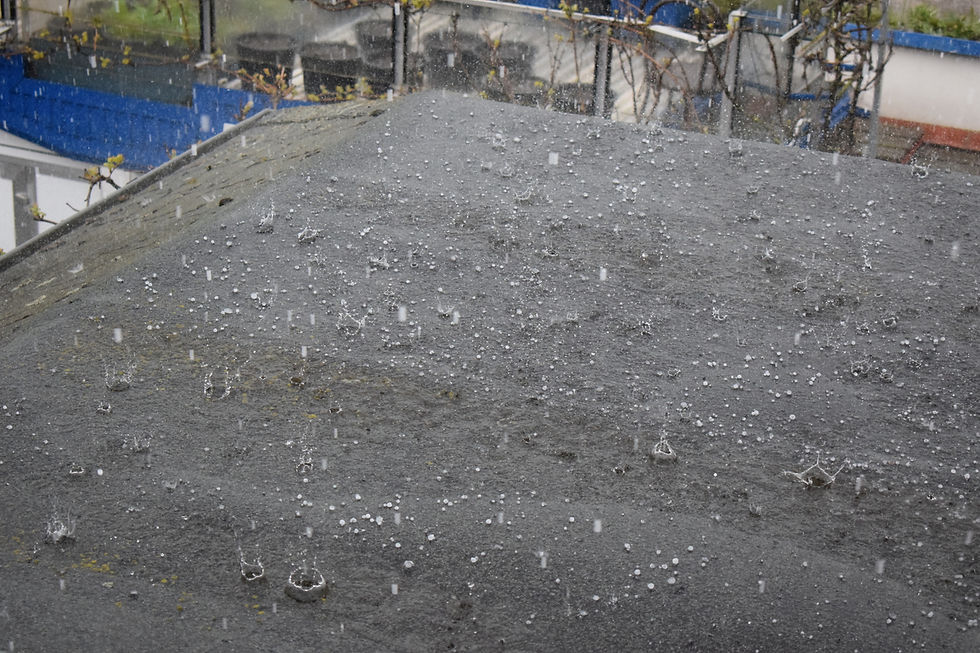
Hail events 25 mm or larger
Within 48 hours. Insurance Bureau of Canada data shows insurance claim windows tighten quickly after events; documented inspection within 48 hours strengthens the claim.
Wind events over 90 km/h
Within 1 week. Wind damage often shows at edges, coping caps, and equipment-mounted components rather than the field membrane.
Interior leak reports
Within 24 hours during business hours, the next business day for after-hours discovery. Same-day temporary repair followed by scheduled permanent repair.
Frequently Asked Questions
Can quarterly inspections be combined into bi-annual visits?
For some lower-risk Calgary buildings (newer roofs under 5 years, single-tenant occupancy, no rooftop equipment), bi-annual may be acceptable. For most commercial buildings, the climate event windows justify quarterly. NDL warranty terms should be checked; many require minimum semi-annual, but performing quarterly provides better documentation and earlier damage detection.
How long does a quarterly inspection take?
For a typical 20,000 sq. ft. Calgary commercial building, 4 to 8 hours per visit including documentation. Larger buildings, more rooftop equipment, or complex roof geometry add time. Annual total runs 16 to 32 service hours.
What happens if I miss a quarter?
The most common consequence is delayed problem detection. A penetration boot that fails in May goes undetected until August or beyond, allowing intermediate freeze-thaw and rainfall events to enlarge the issue. Warranty compliance documentation also suffers; some NDL warranties require continuous documentation.
Can the same contractor do all four quarterly visits?
Yes, and it's preferable. Continuity of inspection records, year-over-year comparison of known stress points, and a single point of contact for warranty and emergency response all favour a single maintenance contractor.
What's included in the documentation a contractor should provide?
Minimum: inspection date, technician name, weather conditions, photo log with location markers, written summary of conditions found, repair recommendations with priority and budget estimates, completion confirmation of prior-visit recommendations. Comprehensive contracts often include year-over-year trend reporting and warranty compliance reports for owner retention.

About Superior Roofing: Superior Roofing Ltd. provides Calgary commercial roof maintenance throughout the city, specializing in quarterly inspection programs with full photo documentation, warranty compliance reporting, and same-day emergency response delivered by Red Seal Journeymen for property managers requiring trusted, system-specific commercial roof care.
Ready to put your Calgary commercial property on a documented quarterly maintenance schedule? Superior Roofing helps Calgary property managers preserve manufacturer warranties and extend system life, backed by 25+ years of local experience, certifications across Sika, SOPREMA, Carlisle SynTec, Duro-Last, and Holcim Elevate systems, and $10 million general liability insurance.
Contact us today at 403-464-3812 to book your free Calgary commercial roof maintenance consultation.
Disclaimer: Roofing involves safety risks; consult licensed professionals for work beyond ground-level visual checks. Costs and specifications provided are estimates based on typical Calgary market conditions and may vary based on specific project requirements and current material pricing.


Comments