
Attic Inspection and Ventilation Maintenance for Calgary Homes

Quick Answer: Calgary attic ventilation requires balanced intake (soffit vents) and exhaust (ridge vents or box vents) following the 1:300 rule (1 square foot of net free vent area per 300 square feet of attic floor), split 50/50 between intake and exhaust. Inadequate or imbalanced ventilation causes ice damming, shingle degradation, mould, and voided manufacturer warranties. Pair ventilation with R-50 insulation for Calgary's freeze-thaw climate.
The attic is where many Calgary roof problems begin and end. Poor ventilation drives ice damming, accelerates shingle aging, and creates mould-friendly conditions. Most Calgary homes built before 1990 have under-ventilated or unbalanced attics; attic inspection and ventilation maintenance can identify blocked vents, moisture problems, and airflow imbalances before they lead to costly roof damage.
At a Glance
Quick Facts:
Ventilation rule: 1 sq ft of net free vent area per 300 sq ft of attic floor
Balance: 50% intake (soffit), 50% exhaust (ridge or box vents)
Calgary insulation standard: R-50 minimum
Average existing insulation in pre-1990 Calgary homes: R-20 to R-30
Inspection frequency: Annual minimum, more after roof work
Highest-leverage upgrade: Top up insulation to R-50
Why Ventilation Matters in Calgary
Three failures result from poor attic ventilation.
Ice damming
Warm attic air melts snow on the upper roof. Water runs down to the cold eave, refreezes, and creates the dam that backs water under the shingles. The Calgary classic, costing $1,500 to $3,500 per repair event.
Shingle degradation
Inadequately ventilated attics reach 60°C in summer. The heat radiates through the deck and bakes shingles from below, shortening their life by 5 to 10 years.
Moisture and mould
Heating and cooking moisture rises into the attic. Without exhaust, it condenses on rafters, leading to mould, wet insulation, and deck rot.
Most manufacturer warranties are conditional on adequate ventilation. Voiding the warranty is the secondary cost of poor ventilation; the primary cost is shorter roof life and more frequent repairs.
The Ventilation Math
Use the 1:300 rule.
Total net free vent area needed = attic floor area ÷ 300
For a typical 1,800 sq ft Calgary home with a 1,500 sq ft attic: 1,500 ÷ 300 = 5 sq ft of net free vent area needed.
Split 50/50: 2.5 sq ft intake at soffits, 2.5 sq ft exhaust at ridge or box vents.
Why balance matters. Unbalanced ventilation (more exhaust than intake or vice versa) reduces effectiveness. Heat exits through exhaust, pulling cool intake air through the soffit. Without matching intake, the exhaust pulls conditioned air from inside the home (driving up heating bills and creating negative pressure).
How to Inspect Your Attic
Annual inspection during daylight hours.
Look for:
Wet or compressed insulation
Frost on rafters or nails (winter check)
Water staining on rafters or sheathing
Mould (black, green, or white patches)
Daylight visible through the deck
Daylight at the soffit vents (intake working)
Visible exhaust at ridge or box vents
Confirm vent function:
Soffit vents: Should be visibly open and not blocked by insulation
Ridge vent: Continuous along the peak, no debris blockage
Box vents: Each unit clear of debris
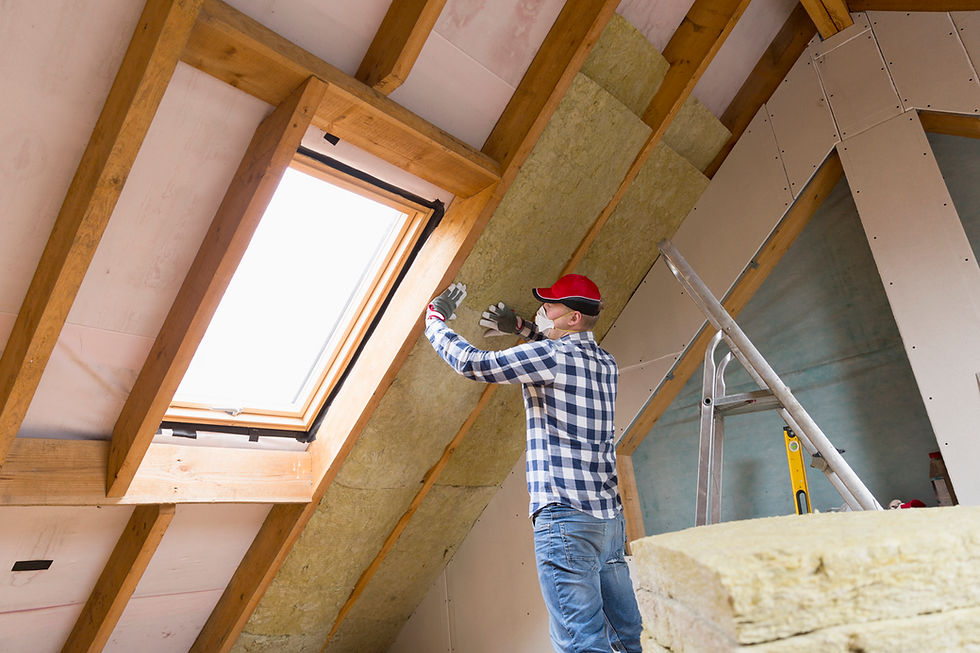
Check insulation depth:
Use a ruler or measuring stick
R-50 = roughly 17 inches of cellulose or 15 inches of fibreglass
R-30 = roughly 10 inches; R-20 = roughly 7 inches
Common Calgary Ventilation Problems
Several patterns show up repeatedly.
1. Soffit vents painted shut. Common on older homes where exterior paintwork sealed the vents.
2. Soffit vents covered by insulation. Top-ups push insulation against the vent from inside, blocking airflow.
3. Imbalanced ventilation. Lots of exhaust vents without matching intake (or vice versa).
4. Mixing ridge vents with box vents. Doing both can short-circuit airflow; choose one or the other.
5. No ridge vent on older homes. Pre-1990 Calgary homes often have only box vents that aren't enough exhaust area.
6. Bathroom or kitchen exhaust venting into attic. Should vent through the roof, not into the attic space.
Pairing Ventilation with Insulation
Ventilation alone doesn't solve all ice dam or efficiency problems. Insulation completes the system.
The Calgary standard: R-50.
This is the modern code minimum for new construction and the practical target for retrofits.
Most Calgary homes built before 1990:
R-20 to R-30. Below the modern standard by 40% to 60%.
Top-up cost:
$1.50 to $3 per square foot of attic floor depending on existing conditions. For a typical 1,500 sq ft attic: $2,250 to $4,500 to top up to R-50.
Payback:
Reduced heating bills (10% to 20% typical savings in Calgary's climate) plus ice dam prevention plus extended shingle life. Most homeowners see 5- to 7-year payback.
Best time to top up:
During a roof replacement (the deck is accessible) or as a standalone winter-prep project in fall.

When to Call a Professional
Attic inspection and ventilation maintenance are worth considering when ventilation balance requires professional assessment. Reasons include:
Calculating net free vent area requires identifying every intake and exhaust vent and looking up manufacturer NFA ratings
Identifying short-circuited airflow patterns requires experience
Recommending the right intervention (more intake vs more exhaust vs both) depends on the specific imbalance
Some interventions require working in the attic and on the roof
Cost for a professional ventilation assessment: $200 to $500 typical. Often part of a maintenance plan.
The assessment is worth doing once on any home where:
Ice dams form regularly
Attic shows condensation or mould
Cooling bills are unusually high in summer
The roof is approaching age 15+ years, and you want maximum remaining life
Frequently Asked Questions
How can I tell if my attic ventilation is balanced?
Visual inspection of intake and exhaust vents, plus calculating net free vent areas. Most homeowners can't accurately assess balance from observation alone; a professional ventilation assessment is the reliable answer.
Will adding more exhaust vents fix my ice dam problem?
Only if your current ventilation is exhaust-deficient, adding exhaust without matching intake can make things worse by creating negative pressure that pulls conditioned air from the home. Diagnose first.
Is power-vented (electric or solar) attic ventilation worth it in Calgary?
Sometimes, for specific situations (large attic areas with poor passive ventilation potential). For most Calgary homes, balanced passive ventilation is more reliable and lower-cost. Power vents add maintenance and electricity use.
Does insulation level affect ventilation needs?
Yes, indirectly. Better insulation reduces heat transfer to the attic, which reduces the work ventilation has to do. R-50 + balanced ventilation is the working combination for Calgary.
Will the previous owner's ventilation upgrades still be valid?
Generally yes for the physical infrastructure (vents installed remain useful). However, warranty documentation may not transfer. Your maintenance documentation starts from your ownership.

About Superior Roofing: Superior Roofing Ltd. provides Calgary residential roof maintenance throughout the city, specializing in ventilation assessment, insulation upgrades, and warranty-compliant attic work delivered by Red Seal Journeymen for homeowners requiring trusted, balanced attic systems.
Ready to assess your Calgary home's attic ventilation and insulation? Superior Roofing helps Calgary homeowners get a complete attic system review backed by 25+ years of freeze-thaw experience and warranty-eligible upgrade work.
Contact us today at 403-464-3812 to book your free residential roof maintenance quote.
Disclaimer: Roofing involves safety risks; consult licensed professionals for work beyond ground-level visual checks. Costs and specifications provided are estimates based on typical Calgary market conditions and may vary based on specific project requirements and current material pricing.


Comments